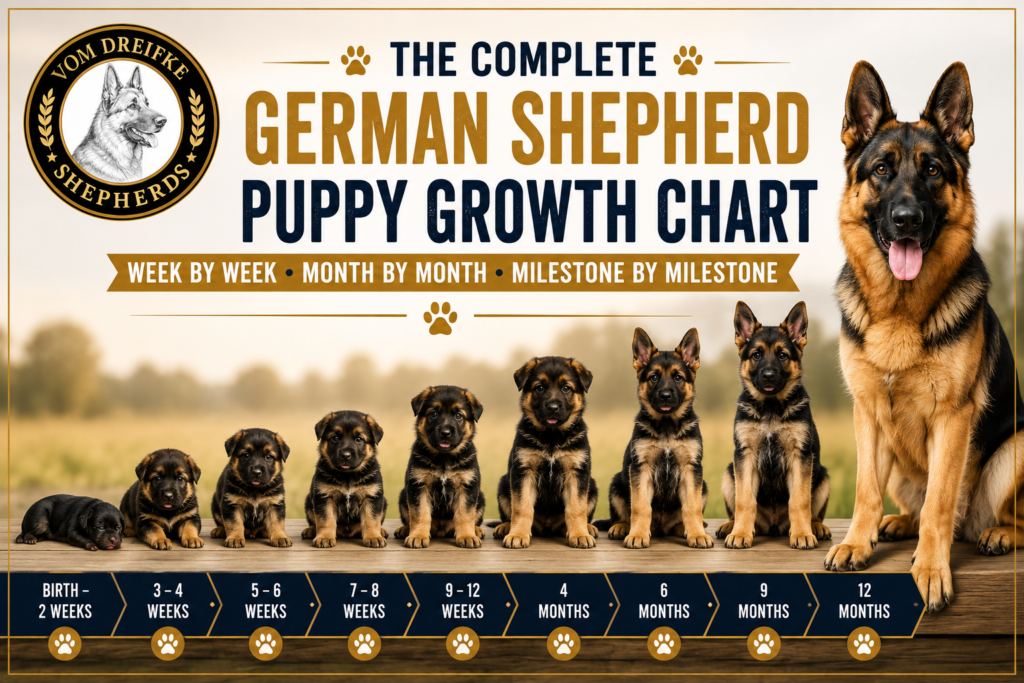
One of the most exciting parts of bringing home a German Shepherd puppy is watching them grow from a tiny bundle of fur into a strong, intelligent, and confident adult dog. German Shepherds grow quickly during their first year, but every puppy develops at their own pace.
Some puppies experience rapid growth spurts, while others mature more gradually. Genetics, nutrition, exercise, overall health, and gender all influence how quickly a puppy grows.
At Vom Dreifke German Shepherds, we often hear questions like:
- Is my puppy the right weight?
- When will their ears stand up?
- When do they stop teething?
- How big will they get?
- When will they calm down?
This guide walks you through what you can generally expect during your German Shepherd puppy’s first year.
German Shepherd Puppy Growth Timeline
While every puppy is different, most German Shepherds follow a similar pattern of development.
Birth to 2 Weeks
Your puppy is completely dependent on their mother.
During this stage they:
- Cannot see well
- Cannot hear well
- Sleep almost constantly
- Nurse every few hours
- Begin gaining weight rapidly
Healthy puppies should steadily gain weight every day.
3 Weeks
Your puppy begins exploring.
Development includes:
- Eyes fully open
- Hearing improves
- Walking becomes steadier
- First interactions with littermates
- Baby teeth begin appearing
This is the beginning of early social development.
4 Weeks
German Shepherd puppies become much more active.
They begin:
- Playing
- Running
- Wrestling
- Exploring new objects
- Eating softened puppy food
- Learning bite inhibition from littermates
5 Weeks
Confidence continues growing.
Puppies begin:
- Learning social skills
- Becoming curious
- Playing more vigorously
- Developing unique personalities
Breeders begin observing temperament differences.
6 Weeks
This is an important learning period.
Puppies continue:
- Socialization
- Handling
- Early confidence building
- Exposure to household sounds
- Learning from littermates
Most puppies weigh approximately 10–15 pounds, although size varies.
7 Weeks
Many breeders perform temperament evaluations around this age.
Puppies become:
- More confident
- Curious
- Playful
- Interested in people
- Better problem solvers
8 Weeks
This is the age many puppies go home.
Average weight:
- Male: 15–20 pounds
- Female: 12–18 pounds
Your puppy should begin learning:
- House training
- Crate training
- Name recognition
- Basic commands
- Socialization
9–10 Weeks
Your puppy gains confidence daily.
Expect:
- More energy
- More chewing
- Increased curiosity
- Rapid learning
- Short attention span
Many puppies experience their first “zoomies.”
11–12 Weeks
Average weight:
- Male: 22–30 pounds
- Female: 20–28 pounds
Many puppies begin:
- Loose leash walking
- Better recall
- Improved sleep schedule
- Longer play sessions
Some ears may begin standing.
Others remain floppy.
Both are normal.
4 Months
One of the biggest developmental stages.
Average weight:
- Male: 35–40 pounds
- Female: 30–35 pounds
You may notice:
- Heavy teething
- More chewing
- Faster growth
- Longer legs
- Increased confidence
Many ears begin standing permanently during this stage.
5 Months
Your puppy may appear tall and awkward.
Growth often occurs faster than muscle development.
Expect:
- Growth spurts
- Loose coordination
- Increased appetite
- More confidence
Training should continue daily.
6 Months
Halfway through the first year.
Average weight:
- Male: 50–60 pounds
- Female: 40–50 pounds
Your puppy now resembles a small adult.
Teething usually finishes around this age.
Adult teeth should be present.
7 Months
Energy remains high.
Many owners notice:
- Testing boundaries
- Increased independence
- Improved focus during training
- Better bladder control
Continue rewarding good behavior consistently.
8 Months
Muscle development becomes more noticeable.
The puppy still has significant growing left to do.
Many German Shepherds enter adolescence during this period.
9 Months
Average weight:
- Male: 65–75 pounds
- Female: 55–65 pounds
Some dogs begin calming slightly.
Others remain extremely energetic.
Both are normal.
10 Months
Your puppy should now understand:
- Sit
- Down
- Stay
- Come
- Place
- Loose leash walking
Consistency remains important.
11 Months
Growth slows considerably.
Your puppy begins filling out instead of simply getting taller.
12 Months
Your German Shepherd reaches approximately:
Male
- 65–90 pounds
- 24–26 inches tall
Female
- 50–70 pounds
- 22–24 inches tall
Many dogs continue filling out until they are 18–24 months old.
German Shepherd Puppy Weight Chart
| Age | Male | Female |
|---|---|---|
| 8 Weeks | 15–20 lbs | 12–18 lbs |
| 12 Weeks | 22–30 lbs | 20–28 lbs |
| 4 Months | 35–40 lbs | 30–35 lbs |
| 6 Months | 50–60 lbs | 40–50 lbs |
| 9 Months | 65–75 lbs | 55–65 lbs |
| 12 Months | 65–90 lbs | 50–70 lbs |
Remember these are averages.
Healthy puppies vary considerably.
When Do German Shepherd Ears Stand Up?
Most ears stand between:
- 8 weeks
- 5 months
Some puppies take longer.
Ears may:
- Stand one day
- Flop the next
- Stand unevenly
- Alternate for several weeks
This is usually normal.
Avoid taping ears unless recommended by an experienced breeder or veterinarian.
Teething Timeline
German Shepherd puppies generally:
- Begin teething around 3–4 months
- Lose baby teeth
- Develop adult teeth
- Finish teething around 6–7 months
Chewing increases dramatically during this period.
Provide safe chew toys.
Growth Spurts
Growth is rarely steady.
Your puppy may suddenly:
- Gain several pounds
- Grow taller overnight
- Become clumsy
- Eat more
- Sleep more
Growth spurts are normal.
Mental Development
Physical growth is only one part of development.
Your puppy also learns:
- Confidence
- Social skills
- Obedience
- Bite inhibition
- House manners
- Self-control
Training should continue throughout adolescence.
Nutrition During Growth
Choose a high-quality large-breed puppy food.
Avoid:
- Overfeeding
- Excess calcium supplements
- Rapid weight gain
Keeping your puppy lean supports healthy joint development.
Exercise During Growth
Growing puppies need balanced activity.
Avoid:
- Long-distance running
- Excessive jumping
- Repetitive fetch
- Running beside bicycles
Instead focus on:
- Short walks
- Training
- Play
- Mental stimulation
- Controlled exploration
When Do German Shepherds Calm Down?
Many owners ask this question.
Generally:
- 8 weeks–6 months: Puppy stage
- 6–18 months: Adolescent stage
- 18–24 months: Increased maturity
- 2–3 years: Most dogs settle significantly
Training and routine influence behavior as much as age.
Signs Your Puppy Is Growing Normally
Healthy puppies usually:
- Eat well
- Gain weight steadily
- Remain playful
- Learn quickly
- Develop muscle
- Have bright eyes
- Maintain a shiny coat
When Should You Contact Your Veterinarian?
Contact your veterinarian if your puppy:
- Stops gaining weight
- Suddenly loses weight
- Limping develops
- Refuses food
- Seems weak
- Has persistent diarrhea
- Vomits repeatedly
- Appears painful
- Stops growing unexpectedly
- Shows unusual swelling
Early evaluation helps identify potential problems.
Every Puppy Develops at Their Own Pace
Growth charts are helpful guides—not strict rules.
Some German Shepherd puppies mature faster.
Others remain lean and lanky before suddenly filling out months later.
Genetics play a significant role in your puppy’s final size and appearance.
Focus on raising a healthy, confident, well-socialized puppy rather than comparing them to others.
At Vom Dreifke German Shepherds, we carefully breed for health, temperament, intelligence, and correct German Shepherd structure. We are always happy to answer questions and support our puppy families throughout every stage of development.
To learn more about our available puppies, upcoming litters, or adoption process, contact Vom Dreifke German Shepherds.
Call or Text: (804) 896-1066
Website: vomdreifkeshepherds.com