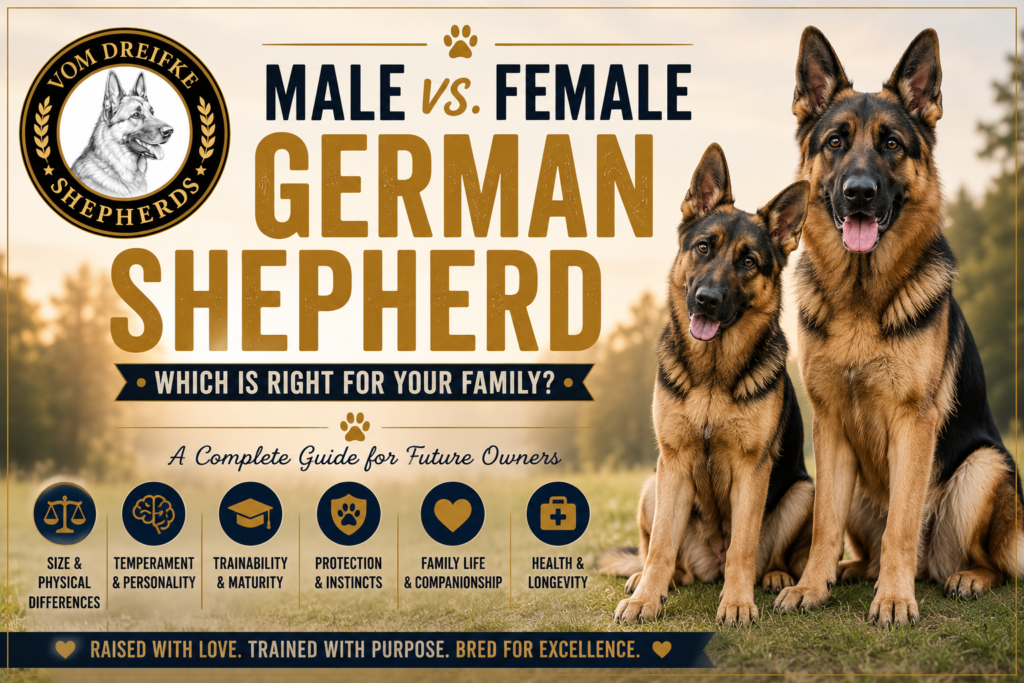
Choosing a German Shepherd puppy is exciting, but one of the first questions many families ask is:
Should I get a male or a female German Shepherd?
The truth is that both male and female German Shepherds can make outstanding family companions, loyal protectors, and intelligent working dogs. The best choice depends on your family’s lifestyle, experience, activity level, and what you’re looking for in a canine companion.
At Vom Dreifke German Shepherds, we believe temperament, health, genetics, and proper training are far more important than gender alone. However, there are some general differences between males and females that may help you make an informed decision.
The Short Answer
There is no “better” gender.
Both males and females are:
- Extremely intelligent
- Highly trainable
- Loyal
- Protective
- Athletic
- Excellent family dogs when properly socialized
The individual puppy’s temperament matters far more than whether it is male or female.
Male German Shepherd Overview
Male German Shepherds are often larger, more powerful, and slightly more confident in unfamiliar situations.
Many owners describe males as:
- More affectionate
- More playful
- More outgoing
- Goofier personalities
- More physically imposing
- Slower to mature mentally
Males often form strong bonds with every member of the household.
Many simply want to be wherever their family is.
Female German Shepherd Overview
Female German Shepherds tend to mature slightly faster both mentally and physically.
Owners often describe females as:
- Highly focused
- Independent
- Observant
- Quick learners
- More serious
- Extremely loyal
Many females develop strong one-on-one relationships with their primary handler.
Size Differences
Generally speaking:
Male German Shepherd
Height:
24–26 inches
Weight:
65–90 pounds
Some working-line males exceed 95 pounds.
Female German Shepherd
Height:
22–24 inches
Weight:
50–70 pounds
Females are usually leaner and lighter than males.
Which One Is Easier to Train?
Both are highly intelligent.
However, females often mature mentally a little earlier.
This sometimes makes them appear easier to train during puppyhood.
Males often remain “puppies” a little longer.
Neither is difficult to train when consistency is used.
Energy Level
Both genders require:
- Daily exercise
- Mental stimulation
- Obedience training
- Socialization
Neither gender should be considered a low-energy dog.
German Shepherds are working dogs that thrive when given jobs to do.
Protection Instincts
Both males and females naturally protect their families.
Generally:
Males
Often rely more on physical presence.
They may appear larger and more intimidating.
Females
Often notice changes in their surroundings quickly.
Many owners feel females are especially alert and observant.
Again, temperament and genetics play a much larger role than gender.
Family Life
Both genders can be excellent family dogs.
A well-socialized German Shepherd should be:
- Gentle with respectful children
- Confident
- Stable
- Friendly when appropriate
- Calm indoors
- Protective without unnecessary aggression
Early training makes the biggest difference.
With Children
Both males and females can do wonderfully with children.
Males may be:
- More playful
- More tolerant
- More physically rough
Females may be:
- More nurturing
- More observant
- Slightly calmer
Regardless of gender:
Always supervise interactions between children and puppies.
With Other Dogs
Socialization is more important than gender.
Generally:
Male-to-male households sometimes require more careful introductions.
Female-to-female households may also experience personality conflicts.
Opposite-sex pairings often coexist well, but every dog is unique.
Maturity
Females
Usually mature sooner.
Many begin settling around:
18–24 months
Males
Often remain more puppy-like until:
2–3 years old
This is one reason many owners describe males as goofy.
Affection
Many owners feel:
Males are:
- Extremely cuddly
- Attention-seeking
- Velcro dogs
- Always nearby
Females are:
- Very loving
- Slightly more independent
- Happy to check in frequently
- Less demanding of attention
Individual personalities vary considerably.
Grooming
There is essentially no difference.
Both genders:
- Blow their coats twice yearly
- Shed year-round
- Need regular brushing
- Require nail trimming
- Need ear cleaning
- Benefit from dental care
Exercise Needs
Neither gender is “lazy.”
Both require:
- Walks
- Play
- Training
- Puzzle toys
- Socialization
- Mental enrichment
Without activity, either gender may develop unwanted behaviors.
Intelligence
German Shepherds consistently rank among the world’s most intelligent dog breeds.
Both males and females excel in:
- Obedience
- Search and Rescue
- Service work
- Therapy work
- Personal protection
- Police K-9 work
- Detection
- Agility
- Competitive obedience
Training and genetics determine success—not gender.
Health Differences
Most health concerns affect both males and females equally.
Responsible breeding helps reduce the risk of inherited conditions such as:
- Hip dysplasia
- Elbow dysplasia
- Degenerative myelopathy
- Certain digestive disorders
Choosing a responsible breeder is far more important than choosing a specific gender.
Personality Differences
Males often are:
✔ Larger
✔ Goofier
✔ More playful
✔ More physically affectionate
✔ Slower to mature
✔ More imposing in appearance
Females often are:
✔ Faster to mature
✔ More focused
✔ Slightly more independent
✔ Very observant
✔ Highly loyal
✔ Easier to manage because of smaller size
Remember:
These are general tendencies—not guarantees.
Which Gender Is Better for First-Time Owners?
Either gender can be an excellent choice.
The key is:
- Choosing a reputable breeder
- Starting training early
- Socializing properly
- Remaining consistent
A well-bred German Shepherd with stable temperament is much easier to raise than one with poor genetics, regardless of gender.
Which Gender Is Better for Protection?
Both genders possess natural protective instincts.
Many working programs successfully use both.
A confident, stable temperament is more important than choosing male versus female.
Proper training should always focus on confidence, obedience, and control.
Which Gender Lives Longer?
On average:
Females often live slightly longer than males.
Typical lifespan:
9–13 years
Good nutrition, exercise, veterinary care, and genetics have the greatest impact on longevity.
Should I Choose Based on Personality?
Absolutely.
At Vom Dreifke German Shepherds, we spend time getting to know each puppy’s temperament.
Some puppies are naturally:
- Confident
- Calm
- Adventurous
- Outgoing
- Gentle
- Independent
- Highly food motivated
- Toy driven
Matching the puppy’s personality to your family is often more important than selecting a male or female.
Questions to Ask Yourself
Before choosing your puppy, consider:
- Do you want a larger dog?
- Do you prefer a more playful personality?
- Would a slightly smaller dog fit your lifestyle better?
- Are you interested in sports or working activities?
- Do you have other pets?
- Are there young children in the home?
- How active is your family?
These answers can help determine the best fit.
Our Recommendation
We encourage families not to become overly focused on gender.
Instead, look for:
- Excellent temperament
- Strong health testing
- Proper socialization
- Confidence
- Intelligence
- Stable nerves
- A breeder who knows each puppy well
The right puppy is the one whose personality matches your home and lifestyle.
Final Thoughts
Whether you choose a male or female German Shepherd, you’ll be bringing home one of the world’s most loyal, intelligent, and versatile dog breeds.
With proper training, socialization, and love, either can become an incredible companion for years to come.
At Vom Dreifke German Shepherds, we carefully evaluate every puppy and enjoy helping families find the perfect match based on temperament, activity level, and lifestyle—not simply gender.
If you’re interested in learning more about our upcoming litters or available puppies, we’d love to help you find your future best friend.
📞 Call or Text: (804) 896-1066
🌐 Website: vomdreifkeshepherds.com