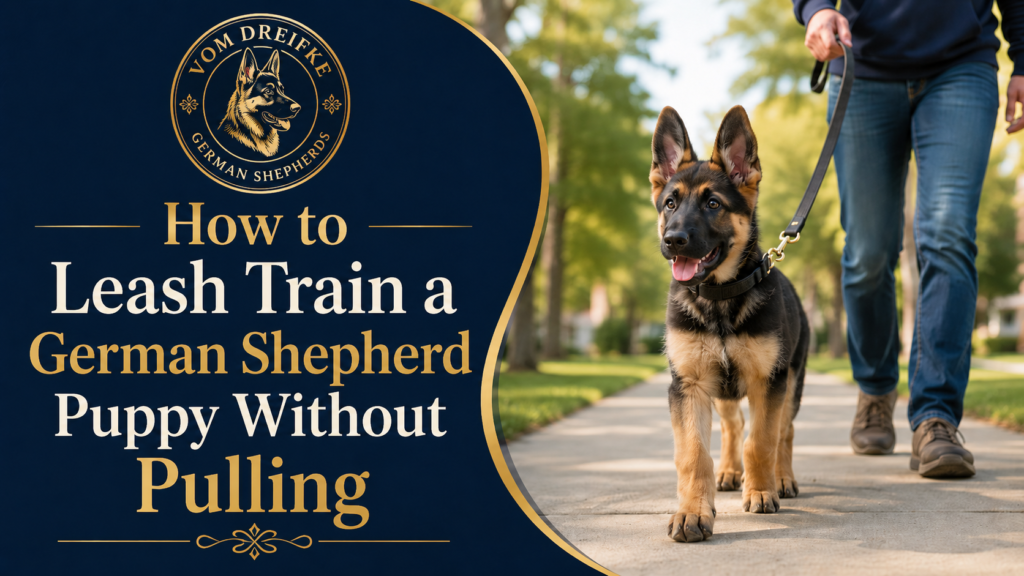
Leash training a German Shepherd puppy should begin early, before the puppy becomes large and powerful.
German Shepherds are intelligent, energetic, and highly aware of their surroundings. A young puppy may pull toward people, dogs, smells, leaves, vehicles, or anything else that captures their attention.
Pulling is not usually an attempt to be disobedient. Puppies naturally move faster than people, become excited by new environments, and have not yet learned that leash pressure means they should slow down or return to their owner.
At Vom Dreifke German Shepherds, we encourage families to begin leash training with short, positive sessions that teach puppies to remain attentive, walk near their handler, and explore safely.
When Should Leash Training Begin?
Leash training can begin as soon as your German Shepherd puppy comes home.
Early sessions do not need to involve long neighborhood walks. You can start inside your home or in a secure private area where there are few distractions.
Begin by teaching your puppy to feel comfortable wearing:
- A properly fitted collar
- An identification tag
- A lightweight leash
- A harness, when appropriate
Allow your puppy to become familiar with the equipment before expecting polished walking behavior.
The first goal is comfort and confidence, not distance.
Choose the Right Collar or Harness
Your puppy’s walking equipment should fit securely without causing discomfort.
A flat collar should be snug enough that the puppy cannot easily back out of it, but loose enough to fit approximately two fingers underneath.
Check the fit regularly because German Shepherd puppies grow quickly.
A well-fitted harness may be helpful for some puppies, especially during early training. However, a harness does not automatically stop pulling.
Avoid equipment that:
- Restricts breathing
- Causes pain
- Rubs the skin
- Is too loose
- Is too heavy for the puppy
- Encourages harsh corrections
Ask a qualified trainer or veterinarian for help choosing equipment when necessary.
Use a Standard Leash
A standard four- to six-foot leash is usually a practical choice for puppy training.
This length allows enough freedom for comfortable movement while helping the owner maintain control.
Retractable leashes may make early training more difficult because they create constant leash tension and allow the puppy to move far ahead.
A puppy learning loose-leash walking should understand that staying near the owner keeps the leash relaxed.
Introduce the Leash Indoors
Attach a lightweight leash and allow your puppy to wear it briefly while supervised.
You may let the puppy drag the leash in a safe indoor area for a few minutes.
Use treats, toys, and praise so the leash predicts positive experiences.
Never leave a puppy unattended while dragging a leash. It may become caught on furniture, crates, doors, or other objects.
If your puppy bites the leash, calmly redirect them to a toy rather than turning the leash into a tug game.
Teach Your Puppy to Follow You
Before expecting a formal walk, teach your puppy that moving with you is rewarding.
Begin in a quiet room.
Take a few steps backward or sideways while encouraging your puppy to follow.
When the puppy moves toward you, reward with:
- A small treat
- Praise
- A toy
- Gentle play
Change directions frequently and keep the session fun.
This helps your puppy learn to pay attention to your movement rather than constantly pulling toward the environment.
Reward the Position You Want
Decide where you want your German Shepherd puppy to walk.
Many owners prefer the puppy to remain beside them or slightly ahead without creating tension on the leash.
Reward your puppy frequently while they are in the correct position.
You may deliver treats near your leg so the puppy learns where rewards appear.
At first, reward every few steps.
As your puppy improves, gradually increase the number of steps between rewards.
Do not wait until the puppy pulls to begin interacting. Reward good walking before the mistake happens.
What Is Loose-Leash Walking?
Loose-leash walking means the leash remains relaxed rather than tight.
The puppy does not need to stay in a perfect competition heel during an ordinary walk.
A practical loose-leash walk allows the puppy to:
- Walk near the owner
- Sniff when permitted
- Change pace calmly
- Notice the environment
- Respond to direction changes
- Avoid dragging the handler
The leash should act as a safety connection rather than the main method of controlling the puppy.
Stop Moving When the Puppy Pulls
One simple method for teaching loose-leash walking is to stop whenever the leash becomes tight.
When your puppy pulls:
- Stop walking.
- Remain calm.
- Wait for the puppy to turn back or reduce the tension.
- Reward when the leash becomes loose.
- Continue walking.
This teaches the puppy that pulling does not move them toward what they want.
Consistency is essential.
If pulling sometimes works and sometimes does not, the puppy may continue trying.
Change Direction
Changing direction can help your puppy learn to monitor your movement.
When the puppy begins moving too far ahead:
- Say the puppy’s name or use a cheerful cue.
- Turn and walk in another direction.
- Reward the puppy for following.
- Continue for several steps.
- Repeat when necessary.
Avoid jerking the leash or sharply pulling the puppy’s neck.
The goal is to encourage attention, not surprise or frighten the puppy.
Teach a Check-In
A check-in occurs when your puppy voluntarily looks at you during a walk.
Reward every spontaneous glance in your direction.
This teaches the puppy that paying attention to the handler is valuable, even when the environment is interesting.
You can also practice saying the puppy’s name once.
When the puppy looks at you, mark the behavior with “yes” or another reward word and offer a treat.
Check-ins are especially helpful before passing distractions.
Start in a Low-Distraction Area
Do not begin leash training in the busiest environment available.
Start in:
- A quiet room
- A hallway
- A fenced yard
- A driveway
- A calm private walkway
Once your puppy can walk with a loose leash in a quiet setting, gradually add distractions.
A puppy that performs well indoors may temporarily struggle outside. This is normal.
New sounds, smells, people, animals, and movement make outdoor walking more difficult.
Keep Walks Short
Young German Shepherd puppies do not need long-distance walks.
Short sessions are better for training and physical development.
A puppy may learn more during a focused five-minute session than during a long walk filled with pulling and frustration.
End the session while your puppy is still successful.
Several short walks or training sessions throughout the day are often more helpful than one long outing.
Let Your Puppy Sniff
Sniffing is mentally enriching and helps puppies explore their environment.
A walk does not need to be entirely focused on strict walking position.
You can teach a release cue such as:
- Go sniff
- Free
- Explore
Allow the puppy to sniff in a safe area, then use a separate cue when it is time to walk with you again.
This creates a balance between training and natural exploration.
Use High-Value Rewards Around Distractions
Ordinary puppy food may work well in quiet settings.
Around stronger distractions, you may need more valuable rewards.
Possible options include very small pieces of:
- Cooked chicken
- Turkey
- Cheese
- Soft training treats
- Another veterinarian-approved food
Keep treats small and include them in your puppy’s total daily food intake.
The reward should be valuable enough to compete with the distraction without causing digestive upset.
How to Handle People During Walks
German Shepherd puppies often become excited when they see people.
Your puppy does not need to greet everyone.
When someone approaches:
- Create enough distance for your puppy to remain calm.
- Ask for attention or a sit.
- Reward calm behavior.
- Allow a greeting only when the puppy remains controlled.
- End the greeting if jumping or biting begins.
Allowing every person to approach may teach the puppy to pull toward strangers.
Calm observation is also a valuable form of socialization.
Walking Around Other Dogs
Do not allow your puppy to pull toward every dog they see.
Frequent on-leash greetings may create frustration, overexcitement, or leash reactivity.
When another dog appears:
- Increase distance if needed
- Reward your puppy for looking at you
- Keep moving calmly
- Avoid tight leash tension
- Do not force interaction
- Choose controlled greetings only with appropriate dogs
Your puppy should learn that seeing another dog does not automatically mean they will meet.
Prevent Jumping During Greetings
Ask your puppy to keep four paws on the ground before receiving attention.
When the puppy jumps:
- Ask the person to pause
- Move the puppy back slightly
- Wait for calm behavior
- Reward a sit or four paws on the floor
- Resume the greeting
The greeting itself can become the reward for calm behavior.
Everyone should follow the same rule.
What to Do When the Puppy Bites the Leash
Leash biting is common in young puppies.
It may happen because the puppy is:
- Excited
- Frustrated
- Tired
- Playful
- Teething
- Overstimulated
When your puppy grabs the leash:
- Stop moving.
- Keep the leash still.
- Offer an appropriate toy or treat.
- Reward the puppy for releasing.
- Resume walking calmly.
Avoid pulling the leash back and forth, which may make it feel like a tug toy.
If leash biting continues, the puppy may need a shorter session or a nap.
Avoid Constant Leash Tension
A constantly tight leash may teach the puppy to lean into pressure.
Try to maintain a soft connection whenever possible.
Reward your puppy when they move back toward you and create slack.
Do not wrap the leash tightly around your hand or allow the puppy to drag you forward.
Good leash handling should feel controlled but not rigid.
Practice at Doors
Doorways are excellent places to teach impulse control.
Before opening a door:
- Ask the puppy to pause or sit.
- Open the door slightly.
- Close it if the puppy rushes forward.
- Reward calm behavior.
- Release the puppy when it is safe to move through.
This helps prevent bolting and teaches your puppy to look to you for direction.
Always secure the leash before opening an exterior door.
Practice Around the Home
Leash manners can be practiced during everyday routines.
Walk your puppy:
- From the crate to the door
- Through hallways
- Around furniture
- To the feeding area
- Across the yard
- Past family members
- Near mild household distractions
Short indoor sessions provide many opportunities for success.
Do Not Drag Your Puppy
Some puppies freeze, sit, or lie down when first introduced to leash walking.
Do not drag the puppy forward.
Instead:
- Encourage with a cheerful voice
- Move backward
- Offer a treat
- Reduce pressure
- Allow the puppy time to observe
- Practice in a quieter setting
Freezing may be caused by uncertainty, fear, fatigue, or physical discomfort.
Check the equipment fit and make sure the surface is not hot, slippery, or painful.
What If the Puppy Refuses to Walk?
A puppy may refuse to walk because they are:
- Overwhelmed
- Tired
- Frightened
- Distracted
- Uncomfortable
- Too hot
- Too cold
- Experiencing pain
Do not assume the puppy is being stubborn.
Shorten the session and return to an easier environment.
Contact your veterinarian if your puppy repeatedly refuses to move, limps, cries, or shows signs of pain.
Avoid Leash Corrections
Harsh leash corrections may cause fear, discomfort, or confusion.
They may also create negative associations with:
- Other dogs
- People
- Vehicles
- New environments
- The handler
German Shepherd puppies learn well through clear reinforcement and consistent boundaries.
Teach the puppy what to do instead of relying on physical punishment.
Teach “Let’s Go”
A movement cue can help your puppy understand when it is time to walk with you.
Say “let’s go” in a cheerful voice and begin moving.
Reward your puppy for following.
Use the cue consistently before changing direction or leaving a sniffing area.
Over time, the phrase can help regain your puppy’s attention.
Teach an Emergency Turn
An emergency turn helps you quickly move away from an approaching dog, vehicle, or unsafe situation.
Practice in a quiet area:
- Say a cue such as “this way.”
- Turn in the opposite direction.
- Encourage the puppy to follow.
- Reward generously.
- Repeat until the puppy turns quickly with you.
Practice before you need it in a real situation.
Walking Near Traffic
German Shepherd puppies should be introduced to traffic gradually.
Begin at a distance where the puppy can remain calm.
Reward the puppy for observing:
- Cars
- Trucks
- Bicycles
- Motorcycles
- Buses
- Delivery vehicles
Do not walk close to heavy traffic if the puppy is frightened.
Increase exposure gradually and maintain secure control of the leash.
Walking in Hot Weather
Pavement may become dangerously hot.
Before walking, place the back of your hand against the surface for several seconds.
If it is uncomfortable for your hand, it may burn your puppy’s paws.
During warm weather:
- Walk early or late
- Use shaded routes
- Bring water
- Keep sessions short
- Watch for heavy panting
- Avoid hot asphalt
Never force a puppy to continue walking when they show signs of overheating.
Walking in Cold Weather
German Shepherds often tolerate cool temperatures well, but young puppies still need protection.
During cold weather:
- Keep walks brief when temperatures are extreme
- Avoid salted or chemically treated surfaces
- Check for ice between the toes
- Dry wet paws and fur
- Watch for shivering
- Use safe traction
Rinse paws after exposure to road salt or deicing chemicals.
Signs Your Puppy Is Overwhelmed
Your puppy may need more distance or a break if they:
- Refuse treats
- Freeze
- Pull desperately
- Bark repeatedly
- Hide behind you
- Tuck the tail
- Attempt to escape
- Become extremely mouthy
- Stop responding to familiar cues
Move to a quieter location and allow the puppy to recover.
Training is most effective when the puppy is able to think and respond.
Sample Leash-Training Session
A simple beginner session may look like this:
Minute 1: Reward the puppy for standing calmly while the leash is attached.
Minute 2: Take several steps indoors and reward following.
Minute 3: Practice changing direction.
Minute 4: Reward eye contact and check-ins.
Minute 5: End with a short sniffing break or play session.
Short, successful sessions build confidence.
Common Leash-Training Mistakes
Avoid these common mistakes:
- Expecting too much too soon
- Walking too far
- Allowing pulling to succeed
- Using a retractable leash during early training
- Giving too few rewards
- Starting in a busy environment
- Allowing every on-leash greeting
- Dragging a frightened puppy
- Jerking the leash
- Training when the puppy is overtired
- Ignoring signs of discomfort
- Changing rules between family members
Consistency helps your puppy understand what is expected.
How Long Does Leash Training Take?
Some puppies understand the basic idea quickly, but reliable loose-leash walking takes practice.
Progress may include:
- Less leash biting
- More frequent check-ins
- Reduced pulling
- Easier direction changes
- Calmer greetings
- Better response around distractions
- Longer periods of loose leash
Expect temporary setbacks in new environments or during adolescence.
Continue rewarding good behavior as your German Shepherd grows.
When to Get Professional Help
A qualified trainer may be helpful if your puppy:
- Pulls so strongly that walking is unsafe
- Lunges at people or dogs
- Panics outdoors
- Bites the leash constantly
- Cannot recover around distractions
- Shows fear or aggression
- Is difficult for family members to control
Early help can prevent unwanted habits from becoming more established.
Choose a trainer who uses clear, humane, age-appropriate methods.
Building Good Walking Habits for Life
Leash training is more than teaching a puppy not to pull.
It teaches your German Shepherd to pay attention, respond to guidance, remain calm around distractions, and explore the world safely.
Begin in quiet environments, use frequent rewards, keep sessions short, and give your puppy time to mature.
With patience and consistency, your German Shepherd puppy can develop into a confident and enjoyable walking companion.
At Vom Dreifke German Shepherds, we believe early training, socialization, structure, and breeder support help families raise well-adjusted German Shepherds.
To learn more about our puppies, upcoming litters, adoption process, or training services, contact Vom Dreifke German Shepherds.
Call or text: (804) 896-1066
Website: vomdreifkeshepherds.com