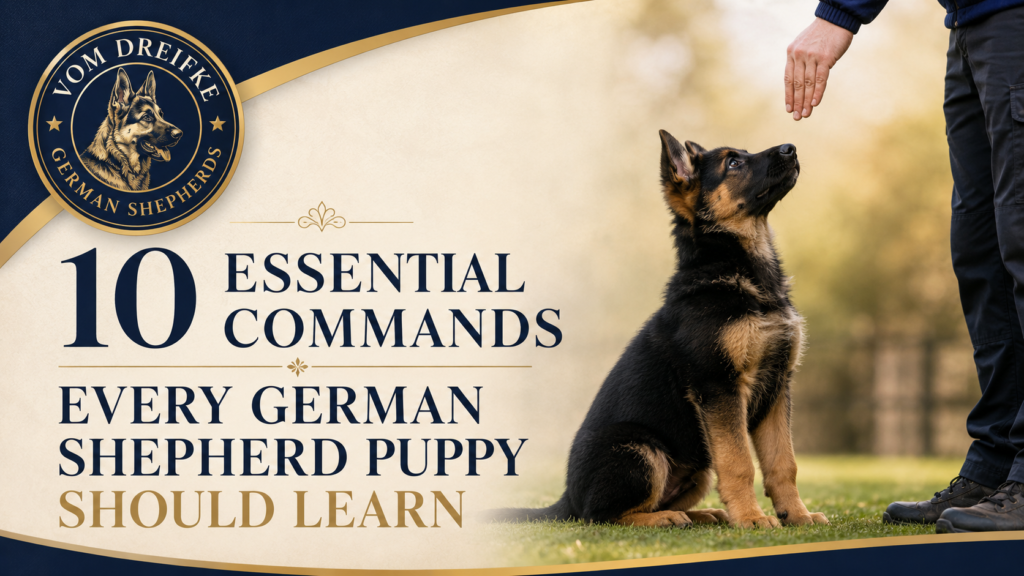
German Shepherd puppies are intelligent, eager to learn, and highly responsive to consistent training. Teaching basic commands early helps create structure, improve communication, prevent unwanted behavior, and build a stronger bond between puppy and owner.
Training does not need to be complicated. Young puppies learn best through short, positive sessions using food, praise, toys, and play.
At Vom Dreifke German Shepherds, we encourage families to begin training as soon as their puppy comes home. The goal is not immediate perfection. The goal is to create clear habits that can develop as the puppy grows.
When Should German Shepherd Puppy Training Begin?
Training can begin on the first day your puppy arrives home.
A young puppy may only focus for a few minutes at a time, so keep sessions brief and enjoyable.
You can practice during normal daily routines, such as:
- Before meals
- During play
- Before opening doors
- After potty breaks
- Before entering the crate
- While walking through the house
- During calm family time
Several short training sessions throughout the day are usually more effective than one long session.
How Long Should Training Sessions Be?
For a young German Shepherd puppy, training sessions may last only two to five minutes.
Stop while your puppy is still engaged.
Long sessions may lead to:
- Frustration
- Boredom
- Increased biting
- Loss of focus
- Overexcitement
- Poor performance
Training should feel successful and rewarding.
As your puppy matures, you can gradually increase the length and difficulty of each session.
Use Positive Reinforcement
Positive reinforcement means rewarding the behaviors you want repeated.
Rewards may include:
- Small treats
- Part of the puppy’s meal
- Praise
- Toys
- Tug games
- Access to something the puppy wants
- Permission to sniff or explore
Reward the puppy immediately after the correct behavior so they understand what earned the reward.
Avoid physical punishment or harsh corrections.
German Shepherd puppies learn more effectively when expectations are clear and training remains consistent.
Teach a Reward Marker
A reward marker tells your puppy the exact moment they performed the correct behavior.
Common markers include:
- Yes
- Good
- A clicker
Begin by saying “yes” and immediately giving the puppy a treat.
Repeat several times.
Soon, the puppy will understand that the word predicts a reward.
Use the marker the moment your puppy performs the desired behavior.
1. Name Recognition
Your puppy’s name should mean, “Look at me.”
Say the puppy’s name once in a cheerful voice.
When the puppy looks at you:
- Mark the behavior with “yes.”
- Give a treat.
- Repeat during short sessions.
Avoid repeating the name many times.
Do not use the puppy’s name mainly when correcting behavior.
You want the puppy to associate their name with attention and positive interaction.
2. Come
A reliable recall is one of the most important skills a German Shepherd can learn.
Begin in a quiet room or fenced area.
Move a few steps away and say:
“Puppy’s name, come!”
Use a cheerful tone.
When the puppy reaches you:
- Mark the behavior
- Reward generously
- Offer praise
- Allow the puppy to return to play when appropriate
Never punish a puppy after they come to you, even if they were slow or doing something unwanted beforehand.
Coming to the owner should always feel safe and rewarding.
3. Sit
“Sit” is useful before meals, greetings, doors, leash attachment, and other everyday activities.
Hold a treat near your puppy’s nose.
Move the treat slowly upward and slightly backward.
As the puppy follows the treat, their bottom will often lower naturally.
The moment the puppy sits:
- Say “yes.”
- Give the treat.
- Praise calmly.
Once the puppy begins sitting consistently, add the verbal command before the movement.
Avoid pushing the puppy’s hips down.
4. Down
“Down” teaches calmness and can help your puppy settle.
Begin with the puppy sitting.
Hold a treat near the puppy’s nose and slowly lower it toward the floor.
Move the treat forward along the ground.
When the puppy lowers their elbows and body:
- Mark the behavior
- Give the reward
- Praise calmly
Some puppies find this position more vulnerable than sitting.
Practice on a comfortable, non-slip surface and remain patient.
5. Stay
“Stay” teaches your puppy to remain in one position until released.
Begin with the puppy sitting.
Say “stay,” pause for one second, and reward before the puppy moves.
Gradually increase:
- Time
- Distance
- Distractions
Change only one difficulty at a time.
Always use a release word such as:
- Free
- Okay
- Break
Do not expect a young puppy to remain still for long periods.
Build the behavior gradually.
6. Leave It
“Leave it” teaches your puppy not to take something.
Place a treat inside your closed hand.
Allow the puppy to sniff or investigate.
The moment the puppy moves away from your hand:
- Mark with “yes.”
- Reward from the other hand.
Repeat until the puppy backs away quickly.
Then add the words “leave it.”
Gradually practice with treats on the floor while keeping them covered and controlled.
This command may help prevent your puppy from picking up unsafe objects.
7. Drop It
“Drop it” teaches the puppy to release something already in their mouth.
Begin with a low-value toy.
Offer a treat near the puppy’s nose.
When the puppy releases the toy:
- Say “drop it”
- Mark the behavior
- Give the treat
- Return the toy when safe
Returning the toy helps teach the puppy that releasing does not always mean losing the item.
Avoid chasing the puppy or pulling objects forcefully from their mouth unless there is an immediate safety emergency.
8. Place
“Place” teaches your puppy to go to a specific bed, mat, or platform and remain there calmly.
Begin by placing a treat on the mat.
When the puppy steps onto it:
- Mark and reward.
- Toss another treat away.
- Allow the puppy to return.
- Reward again when they step onto the mat.
Once the puppy understands, add the word “place.”
Gradually reward sitting or lying down on the mat.
This command can be useful during:
- Meals
- Visitors
- Family gatherings
- Cooking
- Door activity
- Calm household time
9. Wait
“Wait” teaches a temporary pause before moving forward.
It is useful at:
- Doors
- Gates
- Crates
- Vehicles
- Food bowls
- Stairs
Ask your puppy to sit.
Say “wait” and begin opening the door slowly.
If the puppy moves forward, calmly close the door.
When the puppy remains still, release them with “okay” or another release word.
“Wait” is different from a formal stay because it usually means pause briefly until permission is given.
10. Heel or Let’s Go
A practical walking cue teaches your puppy to move with you.
You may use:
- Heel
- Let’s go
- With me
Begin indoors or in a quiet yard.
Hold a treat near your leg and take a few steps.
Reward the puppy for walking beside you with a loose leash.
Keep early sessions short.
A puppy does not need to maintain a perfect formal heel during every walk. The goal is to teach attention and controlled movement.
Teach One Command at a Time
Avoid introducing too many new skills in one session.
Practice one or two commands, then finish with something your puppy already understands.
This helps prevent frustration and keeps training enjoyable.
You may work on different commands throughout the day, but each session should remain simple.
Add Hand Signals
German Shepherds often respond well to visual cues.
Common hand signals may include:
- Palm up for sit
- Hand moving toward the floor for down
- Open palm for stay
- Motion toward your body for come
- Pointing toward a mat for place
Use the same signal consistently.
Over time, your puppy may respond to either the verbal cue or the hand signal.
Do Not Repeat Commands Constantly
Say the command once.
If the puppy does not respond, consider whether:
- The puppy understands the command
- The environment is too distracting
- The reward is valuable enough
- The puppy is tired
- The puppy needs a potty break
- The training step is too difficult
Repeating “sit, sit, sit” may teach the puppy that the first command does not matter.
Instead, make the exercise easier and help the puppy succeed.
Train Before Meals
Using part of your puppy’s meal during training can be effective.
Before placing the bowl down, practice:
- Name recognition
- Sit
- Wait
- Place
- Crate entry
Keep the session short.
Then give the remaining meal.
This allows your puppy to earn food through calm engagement without adding excessive treats.
Practice in Different Locations
A puppy may understand “sit” in the kitchen but seem confused in the yard.
Dogs do not automatically understand that a command applies everywhere.
Practice in:
- The kitchen
- The living room
- The yard
- The driveway
- A quiet sidewalk
- A trusted family member’s home
- A training class
Begin with low distractions and increase difficulty gradually.
Add Distractions Slowly
Do not expect your puppy to perform perfectly around dogs, children, visitors, traffic, or exciting environments immediately.
Build skills in stages.
For example:
- Practice “sit” indoors.
- Practice in the yard.
- Practice near a quiet sidewalk.
- Practice while a person stands at a distance.
- Practice near mild activity.
If your puppy cannot respond, create more distance or return to an easier environment.
Reward Calm Behavior
Training should include more than commands.
Reward your puppy when they:
- Lie down quietly
- Chew an appropriate toy
- Watch people calmly
- Wait without jumping
- Enter the crate
- Settle near the family
- Keep four paws on the floor
- Walk without pulling
Calm behavior is a skill.
German Shepherd puppies need to learn how to relax, not only how to remain active.
Use Real-Life Rewards
Not every reward needs to be food.
You can ask for a simple behavior before giving your puppy something they want.
Examples include:
- Sit before opening the door
- Wait before getting out of the car
- Come before play begins
- Sit before greeting a person
- Look at you before being released to sniff
- Enter the crate before receiving a chew
This teaches the puppy that calm behavior creates access to good things.
Training Around Children
Children can participate in simple training with adult supervision.
They may practice:
- Saying the puppy’s name
- Asking for sit
- Tossing treats onto the puppy’s mat
- Calling the puppy from a short distance
- Rewarding calm behavior
Children should not attempt to correct intense biting, guarding, or overexcitement by themselves.
Keep sessions calm and safe.
What to Do When Your Puppy Loses Focus
A puppy may stop responding because they are:
- Tired
- Hungry
- Full
- Distracted
- Overstimulated
- Confused
- Needing a potty break
- Uncomfortable
End the session or make the exercise easier.
Training should not become a battle.
A short successful session is more valuable than a long frustrating one.
Common German Shepherd Puppy Training Mistakes
Avoid these common mistakes:
- Repeating commands
- Training too long
- Using unclear rules
- Rewarding too slowly
- Expecting adult-level focus
- Increasing distractions too quickly
- Using punishment
- Allowing different family members to use different commands
- Training only when behavior is already difficult
- Failing to reward calm behavior
- Asking for commands the puppy has not learned
- Ending every recall by taking away something enjoyable
Consistency helps your puppy understand what is expected.
Sample Daily Training Routine
A young puppy’s training routine may include:
Morning: Name recognition, sit, and crate entry before breakfast
Midmorning: Come and follow-me games
Afternoon: Leave it, drop it, and handling practice
Evening: Place, wait, and short leash practice
Throughout the day: Reward calm behavior and good choices
Each session may last only a few minutes.
When to Join a Puppy Training Class
A professionally managed puppy class can provide:
- Structured instruction
- Controlled distractions
- Socialization opportunities
- Trainer feedback
- Help with common behavior problems
- Practice around other puppies and people
Ask your veterinarian when it is safe for your puppy to attend based on vaccination status and local disease risk.
Choose a trainer who uses humane, age-appropriate methods.
When to Seek Individual Training Help
Professional guidance may be helpful if your puppy:
- Guards food or toys
- Bites intensely
- Shows significant fear
- Lunges at people or dogs
- Cannot settle
- Panics when left alone
- Becomes difficult to handle
- Shows sudden behavior changes
Early intervention is often easier than waiting for the problem to become established.
Building a Well-Trained German Shepherd
Training a German Shepherd puppy takes patience, repetition, and consistency.
Focus on a few essential commands, reward good behavior, keep sessions short, and practice in different environments.
Your puppy will make mistakes. That is part of learning.
The goal is to build communication, trust, confidence, and reliable habits that can continue into adulthood.
At Vom Dreifke German Shepherds, we believe early training and breeder support help families raise confident, manageable, and well-adjusted dogs.
To learn more about our German Shepherd puppies, adoption process, upcoming litters, or training services, contact Vom Dreifke German Shepherds.
Call or text: (804) 896-1066
Website: vomdreifkeshepherds.com