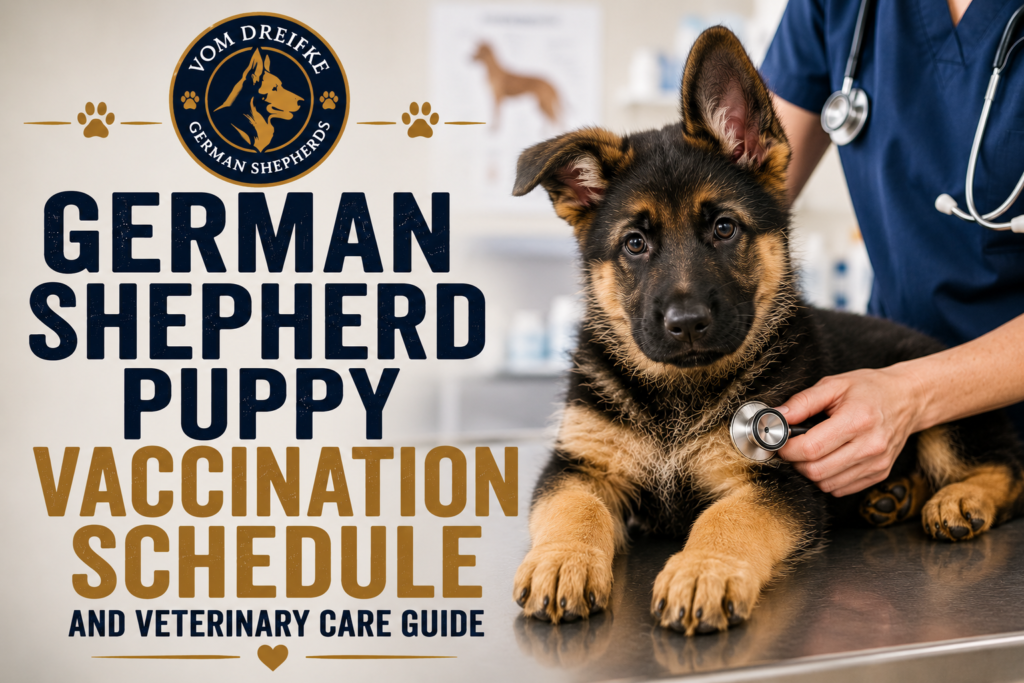
Bringing home a German Shepherd puppy comes with many exciting responsibilities. Along with feeding, training, socialization, and grooming, your puppy will need regular veterinary care to help protect their health as they grow.
Veterinary visits during puppyhood may include physical examinations, vaccinations, parasite testing, deworming, preventive medications, nutrition discussions, and monitoring your puppy’s development.
Because every puppy has a different medical history, lifestyle, and level of disease exposure, your veterinarian should create an individualized health plan for your German Shepherd puppy.
At Vom Dreifke German Shepherds, our puppies receive age-appropriate care before going home. We also provide new families with available health and vaccination records so they can continue care with their own veterinarian.
When Should Your German Shepherd Puppy First Visit the Veterinarian?
Schedule an appointment with your veterinarian shortly after bringing your puppy home.
Even when your puppy has already been examined by the breeder’s veterinarian, an early appointment allows your own veterinarian to:
- Establish a medical record
- Review vaccination history
- Review deworming and parasite prevention
- Perform a physical examination
- Check the puppy’s weight and body condition
- Discuss feeding and growth
- Create a vaccination schedule
- Discuss safe socialization
- Answer questions about behavior and development
- Register or scan the puppy’s microchip
Bring all records supplied by the breeder to the appointment.
These records may include vaccination dates, deworming information, microchip details, feeding instructions, medications, and veterinary examination notes.
Why Do Puppies Need More Than One Vaccination Visit?
Young puppies receive temporary antibodies from their mother. These antibodies help protect them during early life, but they gradually decline.
Maternal antibodies may also interfere with a puppy’s ability to develop a complete response to certain vaccines. Because veterinarians cannot know exactly when those antibodies will disappear in each puppy, vaccinations are normally given as a series.
The series allows the puppy to receive protection as maternal immunity decreases.
Your veterinarian will determine the timing of each dose based on:
- The puppy’s age
- Previous vaccine records
- Health status
- Local disease risks
- Lifestyle
- Travel plans
- Vaccine type
- Manufacturer recommendations
Do not assume that one early vaccination means your puppy is fully protected.
Core Vaccines for German Shepherd Puppies
Core vaccines protect against serious diseases that may threaten dogs regardless of lifestyle.
Your veterinarian may discuss protection against the following diseases.
Canine Distemper
Canine distemper is a contagious viral disease that may affect the respiratory, digestive, and nervous systems.
Symptoms may include:
- Fever
- Nasal or eye discharge
- Coughing
- Vomiting
- Diarrhea
- Weakness
- Muscle twitching
- Seizures
- Changes in behavior
Distemper can be severe and may cause permanent neurological damage.
Canine Parvovirus
Parvovirus is a highly contagious illness that is especially dangerous for puppies.
It can cause:
- Severe vomiting
- Bloody diarrhea
- Loss of appetite
- Dehydration
- Weakness
- Abdominal pain
- Fever or low body temperature
Parvovirus can remain in contaminated environments and may spread without direct dog-to-dog contact.
A puppy with vomiting, severe diarrhea, weakness, or refusal to eat needs immediate veterinary attention.
Canine Adenovirus
Canine adenovirus vaccination helps protect dogs against infectious canine hepatitis.
The disease may affect the liver, kidneys, blood vessels, eyes, and other organs.
Rabies
Rabies is a fatal viral disease that can infect mammals, including people.
Rabies vaccination requirements are determined by state and local laws. Your veterinarian will explain when your puppy should receive the first rabies vaccine and when boosters are required.
Keep the rabies certificate in a safe location.
Leptospirosis
Leptospirosis is caused by bacteria that may be spread through infected urine and contaminated water, soil, or environments.
Dogs do not need to live on a farm or regularly enter lakes to be exposed. Wildlife and rodents may contaminate residential areas.
Leptospirosis may affect the kidneys, liver, and other organs. It can also infect people.
Your veterinarian can explain the recommended vaccination schedule and your puppy’s exposure risk.
What Is the DHPP or DAPP Vaccine?
You may hear your veterinarian refer to a combination vaccine as DHPP, DAPP, DA2PP, or a similar abbreviation.
These combination vaccines commonly protect against diseases such as:
- Distemper
- Adenovirus
- Parvovirus
- Parainfluenza
The exact components may vary by product.
Ask your veterinarian to explain which diseases are included in the vaccine your puppy receives.
General German Shepherd Puppy Vaccination Timeline
Your veterinarian will create the official schedule, but puppy vaccination visits often begin when puppies are approximately six to eight weeks old.
Combination vaccines are normally repeated at intervals during puppyhood, with the final dose timed to provide protection after maternal antibodies are expected to have declined.
A general schedule may include:
Six to Eight Weeks
The puppy may receive:
- Physical examination
- Initial combination vaccination
- Deworming or parasite evaluation
- Stool testing
- Weight and body-condition check
Nine to Twelve Weeks
The puppy may receive:
- Follow-up combination vaccination
- Leptospirosis vaccination when appropriate
- Bordetella vaccination based on lifestyle
- Additional deworming or parasite prevention
- Growth and nutrition evaluation
Twelve to Sixteen Weeks
The puppy may receive:
- Additional combination vaccination
- Rabies vaccination according to local law
- Follow-up leptospirosis vaccination
- Lifestyle-based vaccines
- Continued parasite prevention
Around One Year of Age
Your veterinarian may recommend booster vaccinations based on the products previously administered and the puppy’s individual health plan.
This is a general educational example and should not replace the schedule provided by your veterinarian.
Lifestyle-Based Vaccines
Some vaccines are recommended based on the dog’s environment, activities, and exposure risks.
Your veterinarian may ask whether your German Shepherd will:
- Attend training classes
- Visit a boarding kennel
- Go to dog daycare
- Visit grooming facilities
- Travel
- Hike or camp
- Swim in natural water
- Live near wildlife
- Participate in dog shows or competitions
- Spend time in areas with ticks
- Regularly meet unfamiliar dogs
Depending on these factors, additional vaccines may be discussed.
Bordetella
Bordetella bronchiseptica is one of several organisms associated with infectious respiratory disease, often called kennel cough.
Vaccination may be recommended for dogs that attend:
- Puppy classes
- Boarding facilities
- Daycare
- Grooming salons
- Dog shows
- Training facilities
- Other group-dog environments
Many facilities require proof of vaccination before allowing dogs to enter.
Canine Influenza
Canine influenza vaccination may be considered for dogs that regularly interact with unfamiliar dogs or spend time in group environments.
Your veterinarian can explain whether canine influenza is a concern in your area.
Lyme Disease
Lyme disease is spread through infected ticks.
Vaccination may be considered for puppies that live in or travel to areas where exposure is more likely.
Vaccination does not replace tick prevention or regular tick checks.
When Can a German Shepherd Puppy Safely Go in Public?
Socialization should begin during puppyhood, but it must be balanced with disease prevention.
Your veterinarian can help you determine which activities are safe based on:
- Your puppy’s vaccination status
- Local parvovirus risk
- Disease outbreaks
- The cleanliness of the environment
- The health and vaccination status of other dogs
Before your veterinarian approves public-ground exposure, safer socialization options may include:
- Carrying your puppy in public
- Using a puppy stroller or wagon
- Taking short car rides
- Visiting trusted homes
- Meeting healthy, vaccinated dogs you know
- Allowing observation from the vehicle
- Practicing on private property
- Attending a carefully managed puppy class
- Introducing household sounds and surfaces
Avoid placing an incompletely vaccinated puppy in areas heavily used by unknown dogs unless your veterinarian has said it is safe.
These areas may include:
- Dog parks
- Pet-store floors
- Shared apartment potty areas
- Rest-stop dog areas
- Heavily traveled walking paths
- Uncontrolled group-dog environments
Parasite Prevention for German Shepherd Puppies
Puppies may be exposed to internal and external parasites even when they appear healthy.
Your veterinarian may recommend protection against:
- Roundworms
- Hookworms
- Whipworms
- Tapeworms
- Heartworms
- Fleas
- Ticks
The correct product depends on your puppy’s age, weight, medical history, and location.
Never give a puppy a parasite medication intended for another animal or weight range.
Why Puppies Need Stool Testing
Some intestinal parasites may not be visible in a puppy’s stool.
A veterinarian may request a fresh stool sample to test for parasites such as:
- Roundworms
- Hookworms
- Whipworms
- Giardia
- Coccidia
Puppies may become infected before birth, through nursing, through contaminated environments, or by swallowing infected material.
Symptoms may include:
- Diarrhea
- Vomiting
- Poor growth
- A rounded abdomen
- Blood or mucus in the stool
- Weight loss
- Dull coat
- Reduced energy
Some infected puppies have no obvious symptoms.
Heartworm Prevention
Heartworms are spread through mosquito bites.
An infected mosquito can transmit immature heartworms to a dog. Without prevention, the worms may eventually damage the heart, lungs, and blood vessels.
Your veterinarian will recommend when your puppy should begin heartworm prevention and how often it should be administered.
Depending on your location and veterinary guidance, prevention may be recommended throughout the year.
Give every dose on schedule.
Flea and Tick Prevention
Fleas may cause itching, skin irritation, allergic reactions, and tapeworm exposure.
Ticks may transmit several diseases.
Your veterinarian can recommend a product based on:
- Your puppy’s age
- Current weight
- Coat
- Lifestyle
- Local parasites
- Other pets in the home
- Swimming and bathing habits
Check your puppy after spending time outdoors, especially around the ears, neck, toes, belly, legs, and tail.
Never combine parasite products without veterinary approval.
Microchip Registration
A microchip can help identify your puppy if they become lost, but the chip must be registered with your current contact information.
After bringing your puppy home:
- Confirm the microchip number.
- Register the chip in your name.
- Add your phone number and email address.
- Include an emergency contact.
- Update the information whenever you move or change phone numbers.
A microchip does not replace a secure collar and identification tag.
Ask your veterinarian to scan the chip during routine visits to confirm that it can be detected.
Monitoring Healthy Growth
German Shepherd puppies grow rapidly during their first year.
Your veterinarian will monitor:
- Weight
- Body condition
- Muscle development
- Joint movement
- Heart and lungs
- Eyes and ears
- Teeth and bite
- Skin and coat
- Digestive health
- Behavior and development
Healthy growth does not mean making the puppy as large as possible.
Controlled growth and a lean body condition are important for large-breed puppies.
Feed a complete large-breed puppy food and avoid adding calcium or other growth supplements unless directed by your veterinarian.
Discussing Spaying or Neutering
The appropriate timing of spaying or neutering may depend on:
- Sex
- Breed
- Expected adult size
- Health
- Behavior
- Lifestyle
- Breeding agreement
- Veterinary recommendations
There is no single age that is right for every German Shepherd.
Discuss the potential benefits and considerations with your veterinarian before making a decision.
Follow the terms of your written agreement with the breeder.
Dental Care During Puppyhood
Puppies lose their baby teeth as adult teeth develop.
Your veterinarian will check for:
- Retained baby teeth
- Broken teeth
- Abnormal tooth alignment
- Gum inflammation
- Mouth injuries
- Appropriate adult-tooth development
Begin gentle dental care during puppyhood by introducing dog toothpaste and a dog toothbrush.
Never use human toothpaste.
Provide safe chewing options and avoid extremely hard items that may fracture teeth.
Warning Signs That Require Veterinary Attention
Contact your veterinarian promptly if your puppy develops:
- Repeated vomiting
- Persistent or bloody diarrhea
- Refusal to eat
- Extreme tiredness
- Difficulty breathing
- Collapse
- Pale or blue gums
- A swollen or painful abdomen
- Straining to urinate
- Blood in the urine
- Seizures
- Loss of coordination
- Severe pain
- Persistent coughing
- Eye injury
- Suspected poisoning
- Inability to keep water down
Young puppies may become dehydrated and seriously ill quickly.
When you are uncertain, call your veterinarian rather than waiting for symptoms to become severe.
Possible Vaccine Reactions
Many puppies experience no significant problems after vaccination.
Some may temporarily have:
- Mild soreness
- Reduced energy
- Slightly lower appetite
- Mild tenderness at the injection site
Contact your veterinarian immediately if your puppy develops:
- Facial swelling
- Hives
- Difficulty breathing
- Collapse
- Repeated vomiting
- Severe weakness
- Pale gums
- Extreme distress
Tell your veterinarian about any previous vaccine reaction before future vaccinations.
Keep an Organized Puppy Health Record
Maintain a folder containing:
- Vaccination records
- Rabies certificate
- Microchip information
- Veterinary examination notes
- Parasite-test results
- Medication list
- Food and supplement information
- Insurance information
- Breeder agreement
- Emergency veterinary contact information
Take a photo of important records and store a digital copy.
Boarding facilities, trainers, groomers, landlords, and travel providers may request proof of specific vaccinations.
Questions to Ask at Your Puppy’s Veterinary Visit
Consider asking:
- Which vaccines does my puppy need?
- When is the next vaccination due?
- When can my puppy safely walk in public?
- Which parasite prevention do you recommend?
- Should my puppy receive year-round heartworm prevention?
- Is my puppy growing at a healthy rate?
- Is the current food appropriate?
- How much should my puppy eat?
- When should we discuss spaying or neutering?
- What symptoms require emergency care?
- Where is the nearest emergency veterinary hospital?
- When should the next wellness visit occur?
Writing your questions down before the appointment can help ensure they are all addressed.
Common Puppy Health-Care Mistakes
Avoid these common mistakes:
- Missing vaccine appointments
- Assuming one vaccination provides full protection
- Taking an incompletely vaccinated puppy into high-risk areas
- Using parasite medication without veterinary guidance
- Giving products intended for another animal
- Ignoring vomiting or diarrhea
- Failing to register the microchip
- Overfeeding during growth
- Adding supplements unnecessarily
- Waiting too long to establish a veterinarian
- Losing vaccination records
- Relying only on internet advice when the puppy is ill
Your veterinarian should remain your primary source for individualized medical decisions.
Creating a Healthy Foundation
Regular veterinary care is one of the most important investments you can make in your German Shepherd puppy’s future.
Keep vaccinations on schedule, use appropriate parasite prevention, monitor growth, register the microchip, and contact your veterinarian when symptoms concern you.
Preventive care helps identify potential problems early and gives owners an opportunity to ask questions about nutrition, behavior, development, training, and everyday puppy care.
At Vom Dreifke German Shepherds, our puppies receive age-appropriate veterinary attention before joining their new families. We provide available records and encourage every family to establish a relationship with a trusted veterinarian.
To learn more about our German Shepherd puppies, adoption process, upcoming litters, or training services, contact Vom Dreifke German Shepherds.
Call or text: (804) 896-1066
Website: vomdreifkeshepherds.com