
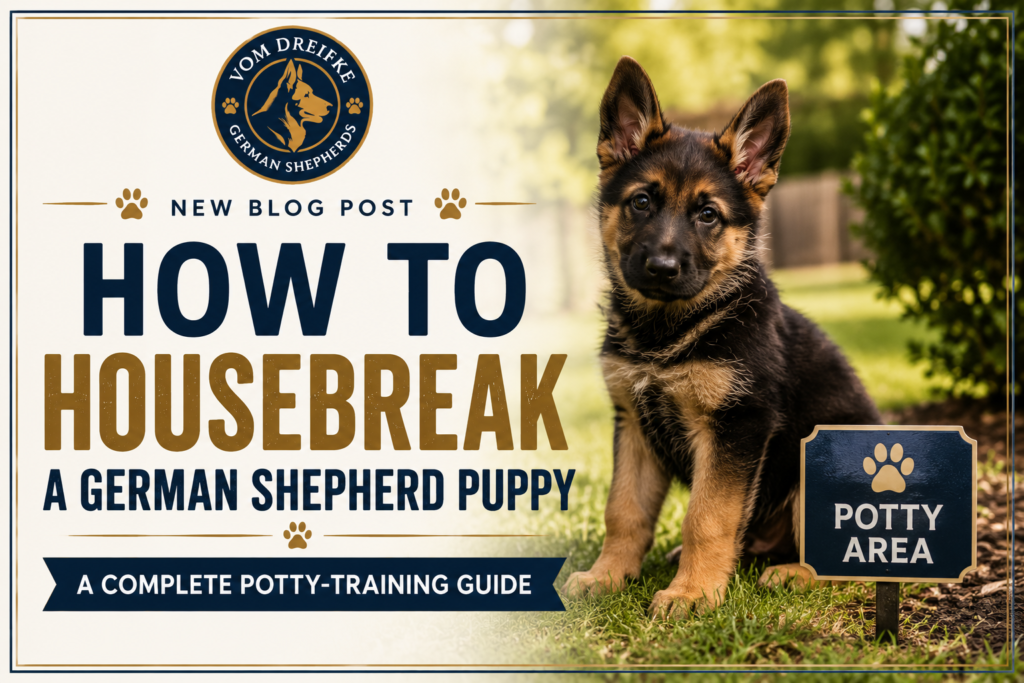
Housebreaking a German Shepherd puppy requires patience, supervision, consistency, and a dependable daily routine. German Shepherds are intelligent and usually learn quickly, but young puppies still have limited bladder control and need frequent opportunities to go outside.
Accidents during the first several weeks are normal. They do not mean your puppy is stubborn, disobedient, or impossible to train. Most accidents happen because the puppy was given too much freedom, waited too long between potty breaks, or was not supervised closely enough.
At Vom Dreifke German Shepherds, we encourage new owners to begin housebreaking immediately and to focus on preventing accidents rather than punishing them.
When Should Housebreaking Begin?
Housebreaking should begin the moment your German Shepherd puppy arrives home.
Before allowing your puppy to explore the house, take them directly to the designated outdoor potty area. Give the puppy a few quiet minutes to sniff and eliminate.
When the puppy goes potty outdoors, reward them immediately with calm praise and a small treat.
This first experience begins teaching the puppy:
- Where to go
- What behavior earns a reward
- Which door leads outside
- What routine to expect
Young puppies learn through repetition. The more successful outdoor potty trips your puppy has, the faster the habit can develop.
Create a Consistent Potty Schedule
A predictable schedule is one of the most important parts of potty training a German Shepherd puppy.
Take your puppy outside:
- Immediately after waking up
- After every nap
- After eating
- After drinking
- After playing
- After training
- Before entering the crate
- Immediately after leaving the crate
- After exciting visitors arrive
- Before bedtime
- Any time the puppy begins sniffing or circling
During the first several weeks, many puppies need to go outside every one to two hours while awake.
Some may need even more frequent breaks after meals, water, exercise, or excitement.
Do not wait for your puppy to clearly ask to go outside during the early stages. At first, you are responsible for creating the schedule.
How Long Can a German Shepherd Puppy Hold Its Bladder?
Bladder control depends on the puppy’s age, activity, sleep, food and water intake, and individual development.
A commonly used estimate is that a puppy may be able to hold its bladder for approximately one hour per month of age. However, this is only a general guideline and may be too long for some puppies while they are awake.
For example:
- An 8-week-old puppy may need to go outside every one to two hours.
- A 12-week-old puppy may sometimes manage two to three hours.
- A 4-month-old puppy may gradually manage longer periods.
Puppies can often hold their bladder longer while sleeping than while awake and active.
Do not expect a very young puppy to remain alone or crated for an entire workday without a potty break.
Choose One Potty Area
Take your puppy to the same general outdoor area whenever possible.
A consistent location helps because previous scent may encourage the puppy to eliminate.
Walk calmly to the area on a leash and avoid turning every potty trip into playtime.
Give the puppy enough time to sniff and settle. Some puppies become distracted by grass, leaves, sounds, people, or other animals.
Once the puppy eliminates, praise and reward immediately.
You can offer a short walk or playtime afterward so the puppy does not learn that going potty always ends the outdoor experience.
Use a Consistent Potty Command
Choose a simple cue such as:
- Go potty
- Hurry up
- Do your business
- Outside potty
Say the phrase quietly while your puppy is beginning to eliminate.
Avoid repeating it constantly before the puppy understands what it means.
Over time, the puppy may begin associating the cue with the behavior. This can be helpful during bad weather, travel, veterinary visits, or busy mornings.
Reward Your Puppy Immediately
Timing is essential.
Give your puppy praise and a small treat within a few seconds of eliminating outdoors.
Do not wait until you return inside. By then, the puppy may not understand which behavior earned the reward.
Use small treats so frequent rewards do not add too many calories.
The reward should make outdoor elimination more valuable than eliminating indoors.
You may say something simple such as:
“Good potty!”
Keep your voice encouraging without becoming so excited that the puppy becomes distracted before finishing.
Learn the Signs Your Puppy Needs to Go Outside
German Shepherd puppies may give subtle signals before an accident.
Watch for:
- Sniffing the floor
- Circling
- Pacing
- Whining
- Wandering away from the family
- Suddenly stopping play
- Moving toward a door
- Becoming restless
- Entering another room
- Returning to a previous accident area
- Squatting
- Looking for a hidden corner
Take the puppy outside immediately when you notice these behaviors.
During early housebreaking, keep the puppy close enough that you can see what they are doing.
Supervision Prevents Accidents
A puppy with unrestricted access to the house is difficult to supervise.
Until your German Shepherd puppy is reliably housebroken, use:
- Baby gates
- Exercise pens
- A crate
- Closed doors
- A leash attached to you
- One puppy-safe room
Keeping your puppy in the same room allows you to notice early potty signals.
Some owners use a lightweight leash indoors and keep the puppy near them. This method is sometimes called tethering.
The puppy should never be left tethered without direct supervision.
Use the Crate to Support Housebreaking
Most puppies naturally try to avoid eliminating where they sleep.
An appropriately sized crate can help your puppy develop bladder control and prevent unsupervised accidents.
The crate should be large enough for the puppy to:
- Stand
- Turn around
- Sit
- Lie down comfortably
It should not be so large that the puppy can use one end as a bathroom.
Take your puppy outside immediately after opening the crate.
Do not allow playtime, wandering, or distractions before the potty trip.
After the puppy eliminates, they can enjoy supervised freedom, training, or play.
Never use the crate to force a puppy to hold their bladder longer than is reasonable.
What to Do When Your Puppy Has an Accident
Accidents are a normal part of housebreaking.
If you catch your puppy beginning to eliminate indoors, calmly interrupt with a neutral sound and take them outside immediately.
If they finish outside, praise and reward them.
Do not:
- Yell
- Hit the puppy
- Rub their nose in the accident
- Drag them to the mess
- Punish them afterward
- Use the crate as punishment
A puppy cannot connect delayed punishment with an earlier accident.
Punishment may teach the puppy to hide when eliminating or become afraid to go potty in front of you.
Instead, treat the accident as information. The puppy may need more frequent trips, better supervision, or less freedom.
How to Clean Puppy Accidents Properly
Use an enzymatic pet cleaner to remove urine and stool odors.
Regular household cleaners may remove the visible mess without fully breaking down the odor.
If the puppy can still smell the accident, they may return to the same area.
Follow the cleaner’s instructions and allow enough contact time.
Avoid cleaners containing ammonia, since the smell may resemble urine to a dog.
Wash soiled bedding promptly and clean the crate thoroughly after accidents.
Keep a Potty-Training Record
A simple written schedule can help you recognize patterns.
Record:
- Meal times
- Water intake
- Potty trips
- Successful elimination
- Accidents
- Naps
- Crate time
- Overnight wake-ups
After several days, you may notice that your puppy usually needs to eliminate a certain amount of time after eating, drinking, or waking.
This makes it easier to prevent future accidents.
Feeding Schedules Can Make Potty Training Easier
Feeding meals at consistent times can make bowel movements more predictable.
Follow the breeder’s or veterinarian’s recommendations regarding the number of daily meals.
Avoid leaving food available all day unless your veterinarian has advised free feeding.
Take your puppy outside shortly after eating.
Many puppies need to have a bowel movement within several minutes to half an hour after a meal.
Do not make sudden food changes. Digestive upset and diarrhea can make housebreaking much more difficult.
Should You Limit Water?
Puppies need regular access to fresh water.
Do not restrict water excessively in an attempt to prevent accidents.
Water may be managed as part of a consistent evening routine, but your puppy should not be left thirsty.
During the day, provide appropriate access to water and take the puppy outside more frequently after drinking.
Speak with your veterinarian if your puppy drinks excessively, urinates unusually often, or seems constantly thirsty.
These symptoms may require medical evaluation.
Nighttime Potty Training
Very young puppies may need one or more potty trips overnight.
Place the crate near your bed so you can hear when the puppy becomes restless.
Before bedtime:
- Avoid overly exciting play
- Take the puppy outside
- Give enough time to eliminate
- Keep the bedtime routine consistent
- Place the puppy calmly in the crate
If the puppy wakes and cries, consider how long it has been since the last potty break.
Take the puppy outside quietly on a leash.
Keep lights low and avoid playing.
After the puppy eliminates, return directly to the crate.
Nighttime potty trips should be calm and uneventful so the puppy learns that nighttime is for sleeping.
What If the Puppy Goes Outside but Does Not Potty?
Some puppies become distracted outdoors and then have an accident immediately after returning inside.
When this happens:
- Take the puppy to the potty area on a leash.
- Wait quietly for several minutes.
- Avoid play and excessive walking.
- Return inside if the puppy does not eliminate.
- Place the puppy in the crate or keep them directly supervised.
- Try again after 10 to 15 minutes.
Do not give the puppy unrestricted freedom after an unsuccessful potty trip.
Once the puppy eliminates outdoors, praise and allow supervised play or exploration.
Potty Training During Rain, Snow, or Cold Weather
German Shepherd puppies still need to follow their routine during unpleasant weather.
Keep outdoor trips focused and use the same potty location when possible.
You may use:
- A covered potty area
- An umbrella
- A cleared section of snow
- A leash to reduce distractions
- A coat for a very young puppy when appropriate
Do not immediately bring the puppy inside simply because it hesitates.
Give the puppy a reasonable chance to eliminate, then reward generously when successful.
Avoid creating indoor potty habits unless you intend to use them long term.
Should You Use Puppy Pads?
Puppy pads can be useful in certain situations, but they may also confuse a puppy that is expected to eliminate only outdoors.
Pads teach a puppy that going potty inside on a particular surface is acceptable.
They may be helpful for:
- Apartments with limited outdoor access
- Severe weather emergencies
- Puppies with medical limitations
- Owners with mobility challenges
- Designated long-term indoor potty systems
For most families with safe outdoor access, taking the puppy directly outside may create a clearer routine.
If pads are used temporarily, transition gradually toward the outdoor area.
Excitement and Submissive Urination
Some puppies urinate when excited, nervous, or greeted enthusiastically.
This is different from a typical housebreaking accident.
To reduce excitement-related urination:
- Keep greetings calm
- Ask visitors to ignore the puppy briefly
- Take the puppy outside before guests arrive
- Avoid leaning over the puppy
- Do not punish the behavior
- Build confidence through positive training
Many puppies improve as they mature and gain better bladder control.
Consult your veterinarian if the behavior is frequent, severe, or continues as the dog gets older.
When Accidents May Indicate a Medical Problem
A previously improving puppy who suddenly begins having frequent accidents may need veterinary attention.
Contact your veterinarian if you notice:
- Straining to urinate
- Frequent small amounts of urine
- Blood in the urine
- Strong or unusual urine odor
- Excessive thirst
- Excessive urination
- Diarrhea
- Vomiting
- Lethargy
- Pain
- Repeated crate accidents
- Loss of bladder control while sleeping
Urinary infections, parasites, digestive illness, and other health conditions can interfere with housebreaking.
Do not assume every accident is behavioral.
Common Housebreaking Mistakes
Avoid these common mistakes:
- Waiting too long between potty breaks
- Giving too much freedom
- Punishing accidents
- Failing to reward outdoor success
- Allowing distractions before the puppy eliminates
- Changing the routine every day
- Using a crate that is too large
- Expecting adult bladder control
- Ignoring early warning signs
- Returning indoors immediately after every successful potty trip
- Cleaning accidents with ordinary cleaner only
- Leaving a young puppy alone too long
Successful housebreaking depends more on management and consistency than correction.
Sample Potty-Training Schedule
Your schedule will depend on the puppy’s age and your household, but an example may look like this:
6:30 a.m. – Wake up and go outside
6:45 a.m. – Breakfast and water
7:00 a.m. – Potty trip
7:30 a.m. – Play and short training
8:00 a.m. – Potty trip and crate nap
10:00 a.m. – Potty trip after waking
10:15 a.m. – Supervised activity
11:00 a.m. – Potty trip
12:00 p.m. – Midday meal, depending on age
12:15 p.m. – Potty trip
1:00 p.m. – Nap
3:00 p.m. – Potty, play, and training
5:00 p.m. – Evening meal
5:15 p.m. – Potty trip
6:30 p.m. – Potty after play
8:00 p.m. – Potty and quiet time
10:00 p.m. – Final potty trip and bedtime
Add additional breaks whenever your puppy wakes, drinks, plays, or shows signs of needing to go.
How Long Does Housebreaking Take?
Some German Shepherd puppies begin understanding the routine within a few days, but reliable housebreaking usually takes longer.
Progress may include:
- Fewer accidents
- Longer time between breaks
- Moving toward the door
- Whining or signaling
- Eliminating quickly in the potty area
- Remaining clean overnight
- Becoming reliable in one room
Do not assume your puppy is fully housebroken after several accident-free days.
Continue supervision and gradually increase freedom.
Changes in schedule, weather, diet, location, or stress may temporarily cause setbacks.
Building Reliable Habits
Housebreaking is not accomplished through punishment. It develops through routine, supervision, timing, prevention, and rewards.
Take your puppy outside often, watch for early warning signs, and celebrate every successful trip.
As your puppy matures, bladder control and communication should improve.
A consistent foundation during puppyhood helps your German Shepherd develop clean, dependable household habits that can last throughout life.
At Vom Dreifke German Shepherds, we believe new owners should have support as their puppies adjust and grow. Families are encouraged to contact us with questions about feeding, housebreaking, training, socialization, and puppy care.
To learn more about our German Shepherd puppies, adoption process, upcoming litters, or training services, contact Vom Dreifke German Shepherds.
Call or text: (804) 896-1066
Website: vomdreifkeshepherds.com